

AI strategy
AI strategy consulting that tells you what to build first
Our AI strategy consulting gives US leadership teams a ranked, costed answer to the question every board is now asking: where should AI go in this business, and in what order? It is for owners, CEOs and COOs of companies with roughly 20 to 1,000 staff who want an AI roadmap tied to real workflows, real budgets and named owners.
Book a free AI review
Two lines is enough. A specialist replies within one business day.
Quick answer
What does AI strategy consulting deliver?
AI strategy consulting delivers a ranked list of use cases scored on value, effort and risk, a 12-month roadmap with budgets and owners, vendor and model recommendations tested on your own data, and the governance rules needed before launch. The output should let leadership approve or reject each project with a clear payback estimate.
- We start from the workflows that cost the most hours, not from the newest model.
- Each use case gets a baseline metric, an owner and a stop condition.
- Vendor choices are settled by testing your own documents, not by benchmarks.
- The AI roadmap sequences projects so later ones reuse earlier data plumbing.
What does an AI strategy consulting engagement include?
It includes discovery interviews, a use-case inventory, scoring, vendor testing, a sequenced roadmap and a governance outline. The work is compact on purpose: a strategy that takes longer than the first project it recommends is usually a sign the scope has drifted.
Discovery means sitting with the people who do the work. We ask finance how month-end close runs, ask sales how leads move from the website into HubSpot or Salesforce, and ask operations which reports eat their Monday mornings. Every answer becomes a line in the inventory with an estimated weekly hour count and the systems it touches.
- Leadership workshop to agree goals, constraints and risk appetite.
- Interviews with five to fifteen people across departments.
- System map covering CRM, ERP, document stores and data warehouse.
- Scored use-case inventory and a recommended first project.
How do you score and rank AI use cases?
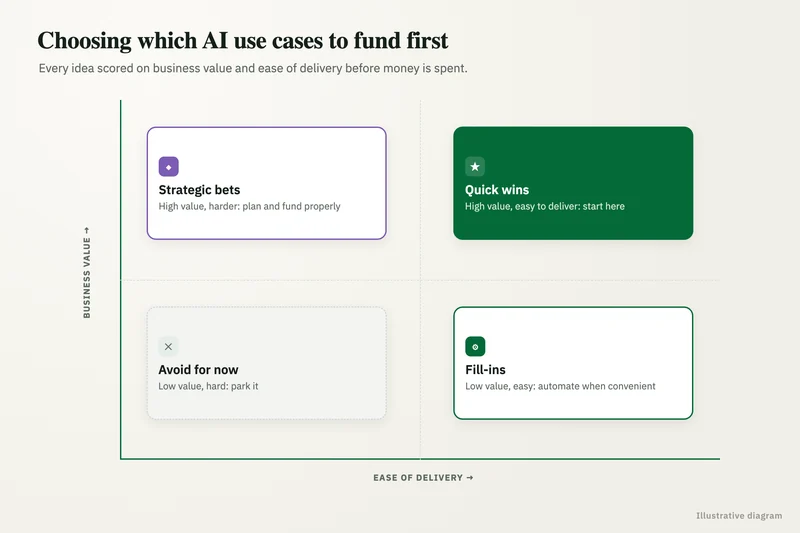
We score each idea on business value and ease of delivery, then adjust for risk. The result is plotted on a value and ease matrix, and the projects in the high-value, high-ease quadrant become the first wave.
Value is measured in hours, errors or revenue: for example, how many analyst hours a week go into building a status report by hand. Ease looks at whether the inputs are structured, whether the systems expose APIs, and whether staff will change how they work. Risk asks what a wrong answer costs and whether a reviewer can catch it in time. A use case that saves a lot of time but sends unreviewed messages to customers usually moves to a later wave, after the review queue is designed.
What you get
What we deliver
Scoped and quoted at a fixed price after a free review.
Use-case inventory
Every candidate idea with weekly hours, systems touched, data source and a value, ease and risk score.
Value and ease matrix
A one-page chart that shows leadership which projects to fund now, later or not at all.
12-month AI roadmap
Three to six sequenced projects with budget ranges, owners, success metrics and decision dates.
Vendor test results
Accuracy and cost per task for the shortlisted models on a sample of your own documents.
Business case
Baseline, expected savings and payback logic for the recommended first project.
Governance outline
Data rules, approval steps and human-review points to put in place before launch.
What does a good AI roadmap look like?
A good AI roadmap is a 12-month sequence of three to six projects, each with a budget range, owner, success metric and decision date. It reads like a capital plan, not a technology wish list.
Order matters more than most teams expect. If the first project connects your document store to a retrieval layer with citations, the second project (say, an internal policy assistant) can reuse it for a fraction of the effort. We design that reuse deliberately. Each project also has a kill criterion, such as accuracy below an agreed level on the eval set after two iterations, so money stops flowing to ideas that are not working.
How do you pick between OpenAI, Claude, Gemini and Copilot?
We pick by testing the shortlisted vendors on twenty to fifty of your real tasks and comparing accuracy, cost per task and data terms. Benchmark tables rarely match the shape of your documents or the tone your customers expect.
Context also narrows the field. A firm already paying for Microsoft 365 may get most of its early value from Copilot before any custom build. A team with strict data residency rules may prefer Amazon Bedrock or an open-weight model in its own cloud. We also look at the build or buy question for each use case: off-the-shelf software wins when the workflow is common, a custom build wins when the workflow is your advantage.
Why does AI strategy consulting matter when most pilots fail?
Because the failure usually starts with the choice of project, not the code. BCG reported in October 2025 that only 5% of companies get value from AI at scale, and that 60% report no material value at all.
The common thread in stalled programs is a pilot picked for its demo value, built without access to production data, and handed to a team that never asked for it. A disciplined AI strategy fixes those three problems up front by tying each project to a measured baseline, confirming data access before the build, and making the department head who benefits the named owner.
What happens after the AI strategy is approved?
You can take the roadmap to any vendor, give it to your internal team, or ask us to deliver the first project. Many clients choose the last option because the people who scored the use case already know the edge cases.
Our case studies include a regulatory consulting firm where a compliance management tool with recurring tasks, owners and reminders cut status reporting from 4-5 hours to under 15 minutes and saved more than 30 hours a month. That kind of back-office project is often where we recommend starting, because it is measurable and low risk.
Case study · Insurance brokerage, Australia
Automation and dashboarding
Policy data arrived as spreadsheets from several insurers, each in a different structure, and every client report took hours of manual cleanup. An automated pipeline that standardizes every insurer's file and feeds a single reporting dashboard.
- Report time cut from 4-5 hours to under 5 minutes
- Reporting accuracy up from about 75% to 99%

How it works
How an engagement runs
- 01
Free review
A call to understand your goals, current tools and the workflows leadership is most worried about.
- 02
Discovery
Interviews and system mapping across departments to build the use-case inventory.
- 03
Score and test
We rank each idea and run shortlisted vendors against your real sample tasks.
- 04
Roadmap review
We walk leadership through the matrix, roadmap and business case, and adjust priorities together.
- 05
First project
We scope the first build at a fixed price or hand a full brief to your chosen team.
FAQ
Frequently asked questions
How long does AI strategy consulting take?
A focused strategy for a mid-size company usually takes a few weeks. The timeline depends mostly on how many departments we interview and how quickly we can see sample data. The exact schedule is written into the fixed-price scope.
How much does an AI strategy engagement cost?
We quote one fixed price after a free review, based on company size and the number of departments in scope. If you want to compare against the market, our AI consultant cost guide lists published third-party ranges for strategy and discovery work.
What is the difference between an AI strategy and an AI roadmap?
The strategy explains where AI fits in the business and why, including the rules it must follow. The roadmap is the dated, budgeted sequence of projects that puts that strategy into action. We deliver both together.
Do we need clean data before building an AI strategy?
No. Part of the strategy work is finding out which data is usable today and which needs fixing. Use cases that depend on messy data are ranked lower or paired with a cleanup task, so the plan reflects reality.
Should we build custom AI or buy off-the-shelf tools?
Buy when the workflow is common across companies, such as meeting notes or email drafting. Build when the workflow depends on your own data, rules or systems and gives you an edge. We make that call for each use case in the roadmap.
Who should be involved in an AI strategy project?
A sponsor from leadership, the heads of the departments in scope, and one or two people who do the daily work in each area. IT or whoever manages your systems should join the vendor and data sessions.
Keep reading
Related pages
Get started
Tell us where AI should pay back
Describe the work that eats your team's time and the systems you run. We reply within one business day with the use cases we would test first, the risks to plan for and a fixed-price proposal.
- Free 30-minute AI review
- Fixed quote before any work starts
- Advice that is vendor-neutral, in plain English
Prefer email? info@aiconsultingservicesusa.com
Book a free AI review
Two lines is enough to start.