
Manufacturing
AI in manufacturing, planned around your ERP, your MES and your quality team
AI in manufacturing pays back fastest in the paperwork, lookups and data entry that surround production, long before anyone touches a machine controller. This page is for owners, plant managers and operations leaders at US manufacturers with roughly 20 to 1,000 staff who want a ranked list of use cases, a governance plan their quality manager can sign off, and a fixed-price engagement to get the first one live.
Book a free AI review
Two lines is enough. A specialist replies within one business day.
Quick answer
How should a mid-size manufacturer start with AI?
A mid-size manufacturer should start with AI in manufacturing on office work tied to production: drafting quality NCRs, comparing supplier quotes, answering work order and inventory questions from the ERP, and keying purchase orders. Choose two or three tasks with usable data and a named owner, keep a person approving changes, and measure hours saved before expanding.
- The quickest wins sit around production: NCRs, RFQs, purchase orders and ERP lookups.
- Every use case is scored on hours saved, data quality, error cost and ownership.
- Nothing changes a work order, spec or purchase order without a named person approving it.
- Engagements are fixed price after a free review, and you own every account and prompt.
Where does AI in manufacturing pay back for a mid-size plant?
It pays back where skilled people spend hours reading, retyping and chasing information. Predictive maintenance and machine vision get the headlines, but most plants under 1,000 staff do not yet have the sensor history those projects need. The office around the floor is a different story: buyers, planners, quality engineers and customer service reps handle documents all day, and language models are good at reading documents.
When we walk a plant, the same time sinks keep appearing. A quality engineer writes up a nonconformance from photos and a shift note. A buyer pastes three supplier quotes into a spreadsheet to compare lead times and unit prices. A planner answers the same 'where is my order' email by opening the ERP, finding the work order and checking routing status. Each of these is a candidate.
- Quality: drafting NCRs and corrective action summaries from inspection notes, photos and past CAPAs.
- Purchasing: reading supplier quotes and RFQ replies into one comparison table for the buyer.
- Order entry: extracting line items from customer purchase orders into the ERP for review.
- Shop floor knowledge: an assistant that answers operators from your SOPs and work instructions, with citations.
- Supplier scouting: finding and screening alternate sources against your approved vendor rules.
- Reporting: weekly OEE and scrap commentary written from MES exports, checked by the plant manager.
Which plant systems does an AI project need to connect to?
Usually the ERP, the MES or its spreadsheets, and wherever SOPs and drawings live. Common ERPs at this size include NetSuite, Epicor, SAP Business One and Plex, and some plants still run a homegrown Access database. Quality records may sit in a QMS, in SharePoint folders or in a shared drive of Excel NCR logs. Maintenance history lives in a CMMS or a clipboard.
We map these during the review because integration effort, not the model, drives most of the cost. A use case that only reads from SharePoint is quick to stand up. One that writes back to the ERP needs an API user, field mapping, a review queue and a rollback plan, so it moves later in the roadmap even if its value is high.
What you get
What we deliver
Scoped and quoted at a fixed price after a free review.
Process walk
Interviews with buyers, planners, quality and customer service, with time spent per task recorded.
Use-case matrix
Every candidate scored on value and ease, plotted so the first projects are obvious.
Systems map
Your ERP, MES, QMS, CMMS and file stores, with what each use case reads and writes.
Governance rules
Approval points, confidence thresholds, logging and data handling rules for drawings and specs.
Sequenced roadmap
Use cases in order, each with an owner, effort estimate and success measure.
Fixed-price scope
A written scope and price for the first use case, ready to build.
How do we rank AI use cases on a manufacturing roadmap?
We score each candidate on four things and plot it on a value and ease matrix. Value is hours per month multiplied by who does the work, plus the cost of the errors it prevents (a missed spec on a PO costs more than a typo in a report). Ease is data availability, integration depth and how clearly someone owns the outcome.
Top-right items go first. In plants we typically see order entry, quote comparison and the SOP assistant land there, while anything that touches machine data or scheduling logic needs more groundwork. The output is a sequenced plan with an estimated effort, a success measure and an owner for each item, so the operations leader can defend the order to the owner or the board.
What governance does AI in manufacturing need?
The main risks are wrong numbers reaching an order, confidential drawings leaving your control, and quiet drift in output quality. Governance for a plant is practical: who approves, what is logged, and which data a model may see.
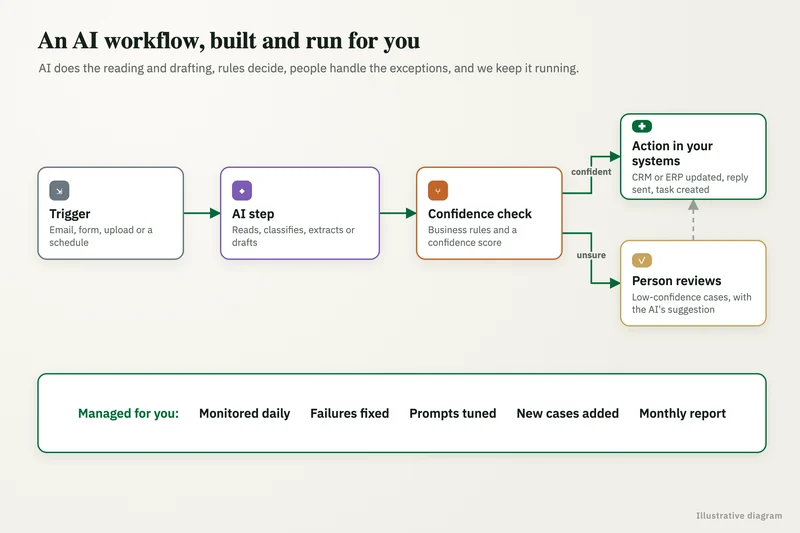
We write rules your quality manager can audit. Extracted PO lines carry a confidence score, and anything under the threshold goes to a human-review queue instead of the ERP. Customer drawings and specifications covered by NDA stay in your own tenant, processed through enterprise or API tiers that do not train on your data. Every prompt and output is logged with the record it touched. Each use case has a small eval set of real past documents that we rerun whenever a prompt or model changes.
- No AI write to a work order, BOM, routing or price without human approval.
- Cost caps per task and per month, with alerts to the owner.
- A written fallback: if the tool is off, the old process still works.
What did supplier scouting look like for a sourcing client?
For a sourcing and supplier quality consultancy, we built two tools: one finds candidate suppliers for a part or material, the other applies the client's own screening rules automatically. The client reported an 85% time saving and a 91% cost saving on supplier scouting. You can read the detail in our case studies.
The lesson for plants is that the screening rules came from the client's buyers, not from us. A good AI in manufacturing project encodes the judgment your team already uses, then frees those people for negotiation and supplier visits.
How does a manufacturing AI engagement run?
It starts with a free review call, then a short discovery where we interview the people doing the work and pull sample documents: a month of NCRs, recent POs, a stack of supplier quotes. From that we deliver the ranked roadmap and a fixed price for the first use case.
If you want us to build it, we do, with your team testing against real documents before go-live. If you have an internal developer or an integrator, we hand over the specification and stay on as advisors. Either way, you own the accounts, the code, the prompts and the data.
Case study · Sourcing and supplier quality consultancy
Supplier scouting automation
Analysts found and filtered suppliers by hand on Google for every client brief. Two tools that find candidate suppliers and apply the client's screening rules automatically.
- 85% time saving
- 91% cost saving

How it works
How an engagement runs
- 01
Free review
A call to understand your plant, systems and the work that eats the most hours.
- 02
Discovery
We interview staff and collect sample NCRs, POs, quotes and SOPs.
- 03
Roadmap
We score use cases, set governance rules and present the sequenced plan.
- 04
First build
We build or specify the first use case and test it on real documents.
- 05
Review and expand
We measure hours saved and errors caught, then move to the next item.
FAQ
Frequently asked questions
What are the best AI use cases for small manufacturers?
For most small and mid-size plants, the best starting points are document-heavy office tasks: customer PO entry, supplier quote comparison, NCR drafting and an assistant over SOPs. They need little new data and show hours saved within weeks. Predictive maintenance usually comes later, once sensor history exists.
Can AI connect to our ERP like NetSuite or Epicor?
Yes, through the ERP's API or a scheduled export, depending on the system. We start with read-only access and only add write-back once a review queue and approval step are in place. Older or homegrown ERPs can often be reached through database views or CSV exports.
Do we need clean data before using AI in a plant?
Not for every use case. Reading supplier quotes or customer POs works on the documents you already receive. Use cases that rely on ERP history, such as demand or scrap analysis, do need consistent part numbers and dates, and the review tells you which of your candidates are affected.
Is it safe to put customer drawings into ChatGPT or Claude?
Not on consumer plans. We route confidential drawings and specs through enterprise or API tiers that do not train on your data, kept in accounts your company owns. We also check your customer NDAs, because some restrict where their files may be processed.
How long does a manufacturing AI roadmap take?
The review and roadmap usually take a few weeks, depending on how many departments are involved and how quickly sample documents arrive. A first use case such as PO extraction can typically follow within weeks after that. We give exact timing with the fixed-price scope.
How much does AI consulting for manufacturing cost?
We quote a fixed price after a free review, based on the number of departments, systems and use cases in scope. For third-party market rates, see our AI consultant cost guide.
Keep reading
Related pages
Get started
Tell us where AI should pay back
Describe the work that eats your team's time and the systems you run. We reply within one business day with the use cases we would test first, the risks to plan for and a fixed-price proposal.
- Free 30-minute AI review
- Fixed quote before any work starts
- Advice that is vendor-neutral, in plain English
Prefer email? info@aiconsultingservicesusa.com
Book a free AI review
Two lines is enough to start.