

Guide
What does an AI consultant do, and when is it worth hiring one?
An AI consultant helps a business decide where artificial intelligence will save time or money, chooses the tools and vendors to do it, and makes sure the result is safe, measured and actually used. This guide explains the work in practical terms for US owners and operations leaders deciding whether they need one, and what they should receive at the end.
Book a free AI review
Two lines is enough. A specialist replies within one business day.
Quick answer
What does an AI consultant do?
An AI consultant studies how a company works, finds the tasks where AI can save time or reduce errors, ranks them by value and risk, recommends tools and models, sets rules for data and human review, and oversees a pilot that measures results. Many also build or supervise the build of the chosen systems.
- The core output is a ranked list of use cases with costs and risks attached.
- Good consultants spend more time on your processes than on AI models.
- Governance, data rules and measurement are part of the job, not extras.
- Some advise only; others, like us, advise and then build.
What does an AI consultant do day to day?
Most of the work is understanding the business, not configuring models. In the first weeks the consultant interviews the people who run each process, watches tasks being done, reads the documents and spreadsheets involved and maps which systems hold which data. That produces a picture of where hours go, where errors happen and where information is copied by hand.
From there the work shifts to design and decisions: scoring possible uses of AI, comparing vendors, estimating costs, drafting rules for data and review, and planning a pilot. During a pilot the consultant tracks results against a baseline, adjusts prompts or workflows and reports to leadership on whether to scale, change or stop.
- Interviews and process walkthroughs with the teams doing the work.
- Data and systems mapping across CRM, ERP, document stores and spreadsheets.
- Use-case scoring on value, ease and risk.
- Vendor, platform and model comparisons.
- Pilot design, measurement and reporting.
What deliverables should you get from an AI consultant?
You should get documents and decisions you can act on, even if you never hire the same consultant again. At minimum that means a use-case shortlist with estimated value and cost, a recommended first project with a design, a tool and vendor recommendation with reasons, a data and review policy for the systems involved, and a measurement plan with today's baseline.
For larger engagements, add a roadmap that sequences projects over six to eighteen months, a governance framework that names owners and approval steps, and a training plan for staff. Be wary of an engagement whose only output is a slide deck of trends; that is research, not consulting.
What does a typical AI consultant engagement look like week by week?
A focused engagement for a mid-size company often runs four to eight weeks before any pilot. Week one is kickoff and access: the consultant meets leadership, agrees what success means and gets read access to the relevant systems and sample files. Weeks two and three are discovery, with interviews, process walkthroughs and a data inventory across tools like HubSpot, NetSuite, QuickBooks, SharePoint or Google Drive.
Weeks four and five turn findings into choices. Use cases are scored, the top one or two get a design, vendors and models are compared on your examples, and costs are estimated per task and per month. The final weeks produce the roadmap, the data and review rules and a pilot plan with a baseline and pass criteria, presented to the people who will approve the budget.
If the firm also builds, the pilot follows directly, usually on a separate fixed price. If not, the documents should be complete enough for your own team or another vendor to pick up without repeating discovery.
How are the right use cases picked?
By scoring each idea on the same criteria and plotting the results. Typical criteria are hours per month the task consumes, cost of errors, how structured the inputs are, whether the data is reachable through an API or export, how easy it is to check the output, and the regulatory or customer risk if it goes wrong.
Ideas with high value and high ease go first. High-value, hard ideas go on the roadmap with the prerequisites listed, such as cleaning a product catalog or moving files off personal drives. Low-value ideas are parked, however exciting they sound. Our guide to AI use cases for business shows the matrix in more detail.
How do you choose between OpenAI, Claude and Gemini?
By testing rather than by preference. A careful consultant builds a small evaluation set from your real examples (fifty to two hundred past emails, documents or tickets with known correct answers) and runs two or three candidate models against it, comparing accuracy, speed and cost per task.
Platform fit often matters as much as raw quality. A Microsoft 365 company may get the most value from Copilot and Copilot Studio because identity and SharePoint access are already in place; an AWS shop may prefer Amazon Bedrock, which offers models from several providers inside its own account; companies with strict data rules may look at open-weight models such as Llama or Mistral running in their own cloud. The consultant's job is to lay out those trade-offs in your terms.
Does an AI consultant handle governance and compliance?
Yes, at a practical level. That means writing rules for which data can go into which tool, ensuring a person reviews outputs that touch money, customers or regulated data, logging prompts and outputs, and checking vendor terms, including whether a Business Associate Agreement is needed when protected health information is involved.
Many consultants structure this around the NIST AI Risk Management Framework, a voluntary US framework with four functions: Govern, Map, Measure and Manage. For companies whose AI output is used in the EU, they will also flag the EU AI Act transparency duties that apply from August 2, 2026. A consultant is not a lawyer, though, and should tell you when a question needs legal counsel. This is not legal advice.
What is the difference between an AI consultant and an AI implementation partner?
An AI consultant focuses on decisions: what to do, in what order, at what cost and under which rules. An implementation partner focuses on delivery: building integrations, writing workflows, connecting models to your systems and keeping them running. Some firms do only one; many, including Greenwolf Tech Labs, do both, with the advisory phase priced and delivered separately.
If you already know exactly what you want built, you may only need an implementation team. If you are unsure where to start, which vendor to trust or how to explain the investment to your board, the advisory work comes first.
AI consultant or fractional Chief AI Officer?
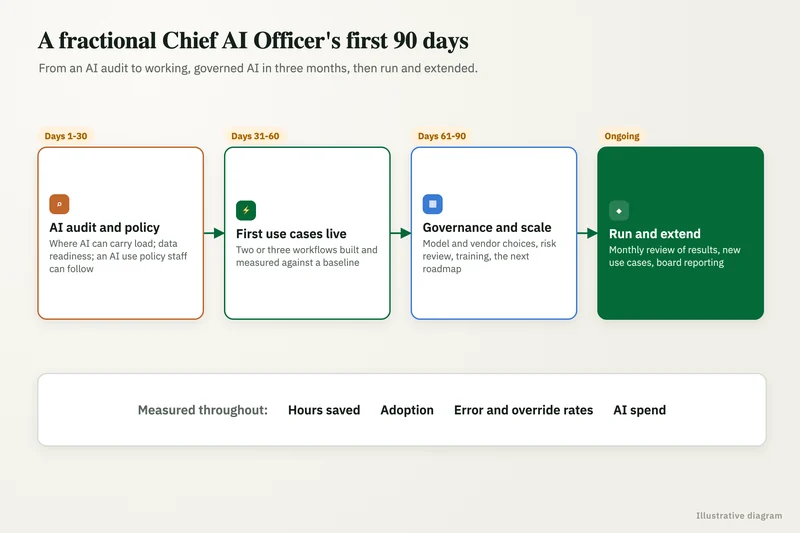
A consultant is usually engaged for a defined project with a start and end. A fractional Chief AI Officer is an ongoing, part-time leadership role: they own the AI roadmap, chair the governance group, manage vendors and report to the CEO, typically for a set number of days a month.
Smaller companies often start with a project-based consultant and move to a fractional role once several AI systems are live and someone needs to own them across departments.
When should a company hire an AI consultant?
Hire one when the decisions are bigger than any one team can make alone. Common triggers are a board or owner asking for an AI plan, several departments buying overlapping tools, staff using personal AI accounts with company data, a stalled pilot or a vendor proposal you cannot evaluate.
You may not need one if you have a single, well-defined task and a capable internal team, or if an off-the-shelf product clearly solves the problem. Adoption is still uneven: the US Census Bureau found 19.8% of US firms used AI as of May 2026, so many companies are making these choices for the first time and benefit from someone who has seen the common mistakes.
A simple test helps: if you can write down the one process you want changed, the systems it touches and the result you expect, you may be ready to go straight to a build. If that page is hard to write, an advisor will usually save more than they cost by writing it with you.
FAQ
Frequently asked questions
What qualifications should an AI consultant have?
There is no single required certification. Look for hands-on experience putting AI systems into production, a background in the business processes you care about, and the ability to explain trade-offs in plain language. Production examples with measured results matter more than titles.
How long does an AI consultant engagement last?
Advisory phases often take two to six weeks. Softude's 2026 guide says a single use case typically takes three to five months from start to production, and multi-department rollouts six to twelve months or more.
Can an AI consultant work remotely?
Yes. Most of the work, including interviews, process walkthroughs, workshops and pilot reviews, runs well over video calls and shared documents. We work remotely with US clients during US business hours.
How much does an AI consultant cost?
It depends on the type of firm and the scope. Our AI consultant cost guide lists published third-party rates, from freelancers to the largest consulting firms, and explains what drives quotes up or down.
Will an AI consultant replace my staff?
A good consultant designs systems that remove repetitive work and leave judgment with people. Most projects shift staff time from copying and checking to handling exceptions and customers, rather than removing roles.
What questions should I ask an AI consultant before hiring?
Ask which process they would start with and why, who will do the work, whether the price is fixed, what you will own at the end and how they handle data. Also ask what happens when the AI is unsure or wrong, and how results will be measured against today's baseline.
Keep reading
Related pages
Get started
Tell us where AI should pay back
Describe the work that eats your team's time and the systems you run. We reply within one business day with the use cases we would test first, the risks to plan for and a fixed-price proposal.
- Free 30-minute AI review
- Fixed quote before any work starts
- Advice that is vendor-neutral, in plain English
Prefer email? info@aiconsultingservicesusa.com
Book a free AI review
Two lines is enough to start.