

AI readiness
An AI readiness assessment before you commit budget
Our AI readiness assessment tells a US company, in plain numbers, whether its data, systems, people and controls can support AI today, and what has to change first. It suits leaders of firms with roughly 20 to 1,000 staff who suspect they are either behind or about to spend on the wrong thing.
Book a free AI review
Two lines is enough. A specialist replies within one business day.
Quick answer
What is an AI readiness assessment?
An AI readiness assessment is a structured review of whether a company can use AI safely and profitably now. It scores data quality and access, system integrations, staff skills, governance and current AI use, then lists the specific gaps to fix and the use cases that are ready to start without waiting.
- Scores cover data, systems, people, governance and the AI already in use.
- We find shadow AI use, such as personal ChatGPT accounts handling company data.
- Every gap comes with an owner, an effort estimate and a priority.
- You leave knowing which use cases can start now and which must wait.
What does an AI readiness assessment measure?
It measures five areas: data, systems, people, governance and current use. Each gets a score with evidence behind it, so the result is something leadership can act on rather than a general maturity label.
Data covers where key records live, how complete they are and whether anyone can get them out without a manual export. Systems covers whether HubSpot, Salesforce, NetSuite, QuickBooks, SharePoint or Google Drive expose usable APIs and permissions. People covers who is already using AI, who could own a project and how much training is needed. Governance covers policies, vendor terms and logging. Current use covers the tools staff are already paying for, officially or not.
- Data: completeness, structure, access and ownership.
- Systems: APIs, user permissions, integration points.
- People: skills, appetite, available owners.
- Governance: policy, vendor terms, audit trail.
- Current use: approved and unapproved AI tools.
How is an AI readiness assessment different from an AI audit?
A readiness assessment looks forward at what you can start; an AI audit looks at what is already running and whether it is controlled. Most companies need a bit of both, so our assessment includes a light audit of existing tools.
That audit part often surprises leadership. It is common to find a sales team pasting customer emails into a personal chatbot account, a finance analyst using an AI add-on in spreadsheets, and a marketing contractor generating content with no review step. None of this is necessarily wrong, but each one needs a decision: approve it on a business plan with proper data terms, replace it, or stop it.
What you get
What we deliver
Scoped and quoted at a fixed price after a free review.
Readiness scorecard
Scores for data, systems, people, governance and current use, each backed by findings.
Shadow AI inventory
A list of AI tools staff already use, with data terms and a keep, replace or stop decision.
System and data map
A diagram of your core systems, where key data lives and how it moves today.
Sample data tests
Results of running a model on a small set of your real records, with confidence levels.
Gap list
Prioritized fixes with owners and effort estimates, ready to drop into a project plan.
Ready-now use cases
One or two projects that can start immediately, each with a rough scope and success metric.
Why check readiness before an AI pilot?
Because most failed pilots fail on data access and fit with daily work, not on model quality. MIT NANDA reported in July 2025 that only about 5% of custom enterprise AI tools reached production, citing brittle workflows and tools that did not fit how people work.
An assessment catches those problems while they are cheap. If invoice data sits in scanned PDFs across three shared drives, a finance automation needs an extraction step and a review queue before it can work. If the CRM has duplicate accounts and empty industry fields, a lead scoring idea needs cleanup first. Knowing that in week two costs far less than finding out in month four.
How do we run the assessment?
We combine interviews, a short staff survey, read-only system access and sample data checks. Nothing is changed in your systems during the review.
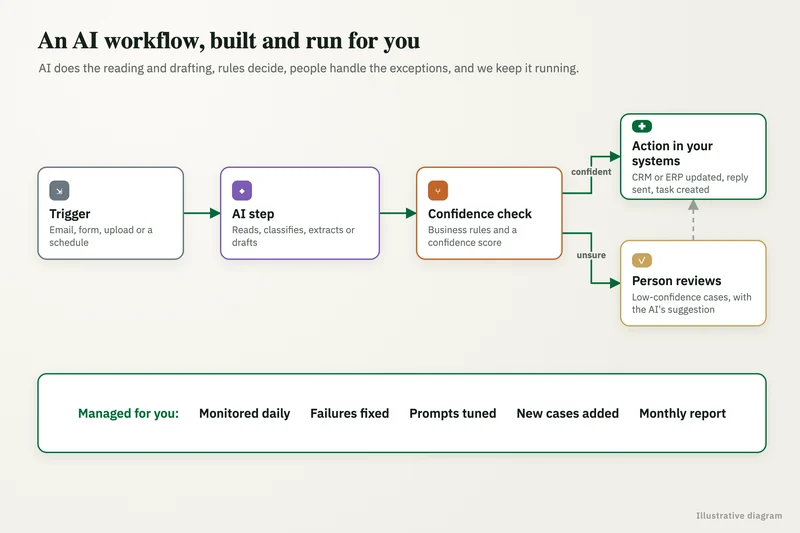
We usually interview department heads and a few hands-on staff, map the systems and data flows, then pull a sample from the records that matter most, for example a month of support tickets or a quarter of purchase orders. We test whether a model can actually work with that sample: can it extract the right fields, answer questions with citations, or classify records at an acceptable confidence level. Low-confidence results show where a human-review step will be needed in any future build.
We also look at volume and timing. A workflow that runs forty times a month rarely justifies a custom build, while one that runs four hundred times a week usually does. Those counts, taken from ticket queues, CRM activity logs or shared mailbox exports, turn a vague sense of busyness into figures you can put in a business case.
What do you get at the end of the assessment?
You get a scored report, a prioritized gap list and a short list of use cases that are ready now. The report is written for leadership and runs to a handful of pages, with the evidence in appendices.
Each gap is written as a task with an owner and an effort estimate, such as adding an API user to NetSuite, moving shared files into one SharePoint library, or approving a business-tier AI plan with data retention turned off. The ready-now list names one or two projects that could begin immediately, with a rough scope so you can decide whether to move straight into a build.
Who should commission a readiness review?
Owners, CEOs, COOs and finance leaders who have to approve AI spending and want an independent view first. It is especially useful when several departments are pushing their own tools, or when a customer or insurer has started asking how the company uses AI.
It also works as a first step before hiring a fractional Chief AI Officer, because it gives that person a baseline to measure against. For smaller firms, the assessment can be compact and focus on one or two departments, which keeps the cost proportionate.
How it works
How an engagement runs
- 01
Free review
A short call to agree which departments and systems are in scope.
- 02
Interviews and survey
We speak with leaders and hands-on staff and run a brief survey on current AI use.
- 03
System and data checks
With read-only access, we map systems and test a model on sample records.
- 04
Report and readout
We present the scorecard, gaps and ready-now use cases to leadership and answer questions.
FAQ
Frequently asked questions
How long does an AI readiness assessment take?
For most small and mid-size companies it takes a few weeks from kickoff to readout. Larger scopes with more departments take longer. The timeline is fixed in the written scope before we start.
How much does an AI readiness assessment cost?
We quote a fixed price after a free review, based on the number of departments and systems in scope. Our AI consultant cost guide lists published third-party ranges if you want a market comparison.
Do you need access to our systems for the assessment?
We ask for read-only access or exports for the systems in scope, plus a small data sample. We do not change any settings or records, and access is removed when the assessment ends.
What is shadow AI and why does it matter?
Shadow AI is staff using AI tools the company has not approved, often on personal accounts. It matters because company or customer data may be going into tools with consumer data terms. The assessment finds it and recommends approved alternatives.
Can a small business benefit from a readiness review?
Yes, as long as it is scoped to match. A small firm usually needs a review of one or two workflows and its main systems, which can be done quickly and still prevents spending on a tool that cannot reach its data.
What happens if we are not ready for AI?
You get a specific list of what to fix and in what order, which is often cheaper than it sounds. Many gaps are permissions, file organization or a missing API user rather than major projects.
Keep reading
Related pages
Get started
Tell us where AI should pay back
Describe the work that eats your team's time and the systems you run. We reply within one business day with the use cases we would test first, the risks to plan for and a fixed-price proposal.
- Free 30-minute AI review
- Fixed quote before any work starts
- Advice that is vendor-neutral, in plain English
Prefer email? info@aiconsultingservicesusa.com
Book a free AI review
Two lines is enough to start.